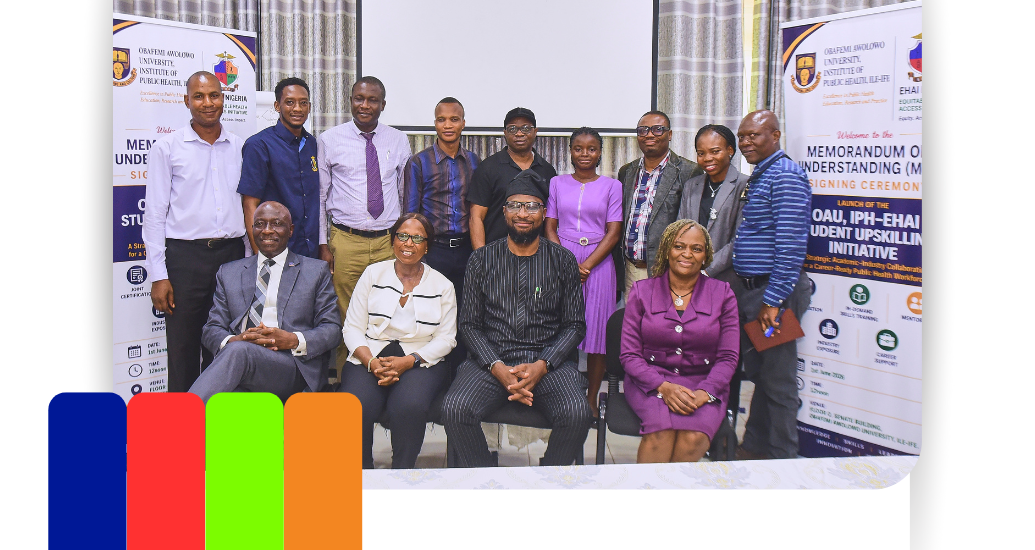
On 1 June 2026, Obafemi Awolowo University (OAU), Osun State — one of Nigeria’s foremost institutions of higher learning — formally partnered with the Equitable Health Access Initiative (EHAI) Nigeria on a programme set to reshape career readiness across the country’s public health sector. The partnership was sealed at a signing ceremony attended by senior university leadership, including the Vice-Chancellor, Professor Adebayo Bamire; the Deputy Vice-Chancellor (Academic), Professor Adesola Aderounmu; the Deputy Vice-Chancellor (Administration), Professor Akanni Akinyemi; the Registrar; the Bursar; the Librarian; College Provosts; Deans; Heads of Department; and the Director of the Institute of Public Health, Professor Esimai Olapeju.
The journey to that signing ceremony, however, began over a decade earlier.
Since 2014, EHAI Nigeria has welcomed interns from public health programmes across the country. And throughout this period, an uncomfortable pattern kept showing up. Bright, qualified graduates walked through the door with strong theoretical foundations, yet struggled to translate that knowledge into the practical demands of the field.
It was not a one-off. It was not an exception. It was systemic — and eventually, it raised a question the organisation could no longer set aside: why are so many of Nigeria’s public health graduates underprepared for the realities of professional practice?
Measuring the Gap
In 2024, EHAI moved from observation to evidence, commissioning a structured assessment of its Internship Development Programme. The resulting survey reached over 1,000 students across more than 14 Nigerian universities, and the findings confirmed what years of internships had suggested: a substantial and measurable gap between academic curricula and industry expectations.
Onyema Maduakolam, Project Coordinator for the EHAI-IPH Collaboration, described the finding plainly:
“We conducted a survey of more than 1,000 students from over 14 universities across Nigeria, and we found that the skill gap was very real. To help close this gap, this upskilling initiative will support public health graduates at all levels in becoming industry-ready.”
— Onyema Maduakolam, Project Coordinator, EHAI-IPH Collaboration, EHAI Nigeria
That survey became the evidentiary foundation for a new, structured response — one designed to be practical, scalable, and capable of genuinely changing outcomes for Nigerian public health graduates.
EHAI’s concerns were not raised in isolation. Senior academics at OAU had been voicing the same alarm from within the university itself. Professor Kayode Ijadunola, Professor of Community Health at Obafemi Awolowo University, offered a candid assessment of what the current training model produces.
“Our master’s and doctoral students, to a large extent, acquire theoretical knowledge and a degree of practical exposure through our training. But with this kind of initiative and partnership, we can go beyond that — toward far greater hands-on capability and field experience.”
— Prof. Kayode Ijadunola, Professor of Community Health, OAU
Professor Ijadunola was equally direct about employer expectations: organisations are no longer hiring on the strength of certificates alone. They are seeking hands-on experience — precisely the kind of exposure initiatives such as the OAU–IPH–EHAI partnership are designed to provide.
This shared concern gave rise to the Student Upskilling Initiative, developed in partnership with the university’s Institute of Public Health. At the signing ceremony, Professor Esimai Olapeju, Director of the Institute, explained why the collaboration was a natural extension of an already strong relationship.
“We have been working together on research for some time, including a number of joint research proposals. We run an internship programme, and we also run training programmes. We decided that we should support one another across both. Our students should not be theoretical alone – they need practical exposure as well. We are academics, and EHAI is in the field, and that combination enriches the learning.”
— Prof. Esimai Olapeju, Director, Institute of Public Health, OAU
Dr Timothy Akimurele, Chief Executive Officer of EHAI Nigeria, described the scale of ambition behind the initiative in equally strong terms.
“This is a life-transforming partnership that will impact the public health space, both locally and globally. We are also preparing participants for the international market, because we are bringing in expertise from professionals who have spent years working with international, multilateral, and bilateral organisations that have implemented major, life-transforming public health projects within Nigeria and beyond.”
— Dr Timothy Akimurele, Chief Executive Officer, EHAI Nigeria
Inside the Programme
The OAU–IPH–EHAI Student Upskilling Initiative is structured as a hybrid programme combining online instruction, in-person bootcamps, and field-based experience. It is open to public health students, recent graduates, and professionals working in allied health disciplines. Participation unlocks:
- In-demand technical skills — SPSS, R, the application of AI in public health, grant writing, research methods, monitoring, evaluation and learning (MEL), and scientific communication
- Mentorship — direct access to seasoned professionals with national and international career experience
- Industry exposure — genuine connections with organisations active in Nigeria’s public health ecosystem and beyond
- Internship placement and career support — structured pathways into the workforce, rather than informal networking alone
- A joint certificate, co-issued by OAU–IPH and EHAI Nigeria, carrying the combined weight of academic and industry credibility
As Dr Akimurele summarised it, the initiative is about “building capacity for the marketplace, locally and internationally, alongside the experience of operating within a genuinely professional environment.”
More Than a Milestone
For EHAI Nigeria, the signing of this Memorandum of Understanding represents more than a milestone — it is a declaration. It affirms that the organisation’s commitment to equitable health access extends beyond service delivery into the very pipeline of professionals who will carry that work forward in the years ahead.
Are you a public health student or recent graduate ready to go beyond the classroom?
Follow EHAI Nigeria across our platforms and enable notifications for updates on the first cohort’s application window.