
Nigeria Is Losing Its Doctors.
Here’s What That Means for You
Think about the last time you needed to see a doctor in Nigeria. The wait was probably long. The consulting room was probably packed. And if you needed a specialist – a cardiologist, a neurologist, an oncologist – you likely had to search, wait weeks, or travel to another state entirely.
That experience is not random. It is the direct, lived consequence of one of the most urgent crises facing Nigeria’s health system today: the mass emigration of Nigerian doctors, nurses, and health professionals.
This isn’t a story about individuals chasing greener pastures. It’s a story about a health system losing its capacity to care for its own people and what it will take to rebuild it.
The Numbers Tell the Story
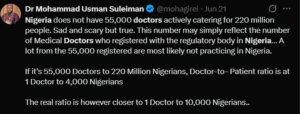
The scale of Nigeria’s healthcare brain drain is staggering, and the data drawn from peer-reviewed research and global health bodies leaves little room for doubt.
Nigeria’s Healthcare Brain Drain — By the Numbers
|

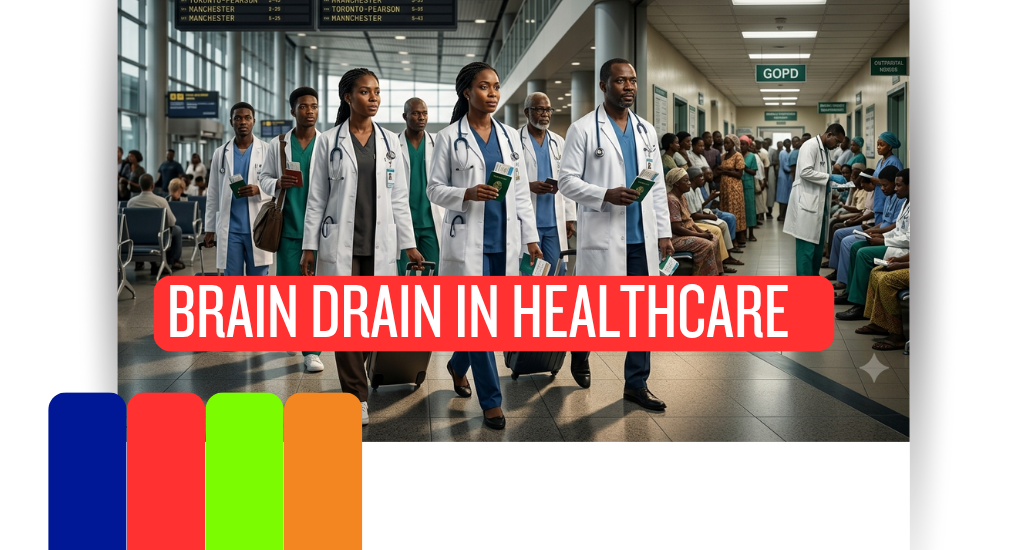
AI-generated Image depicting the emigration of Nigerian doctors
Why Nigeria’s Health Workers Are Leaving
Research consistently points to a mix of push and pull factors. On the push side: poor remuneration, inadequate medical infrastructure and supplies, limited opportunities for specialisation and career growth, and rising insecurity, including reports of health workers being abducted from homes or workplaces (HSCL, 2024). The COVID-19 pandemic intensified this further, with health workers citing inadequate PPE and inconsistent hazard allowances as major grievances (International Journal for Equity in Health, 2022).
On the pull side: significantly higher salaries, safer working environments, structured career progression, and active recruitment by destination countries — the UK’s Health and Care Visa, for instance, was designed specifically to fast-track international medical graduates (International Journal for Equity in Health, 2022).
What This Means for You
This isn’t an abstract policy issue; it shapes everyday access to care for millions of Nigerians. The mass departure of skilled doctors exacerbates an already strained healthcare system, reducing access to quality medical care, especially in rural and underserved areas. Health facilities remain saturated with patients in dire need of medical attention, while health workers are in short supply.
In practical terms, this looks like: fewer specialists available for complex conditions, longer wait times even for urgent care, remaining health workers stretched thin and at higher risk of burnout, and rural communities left with little to no access to qualified medical professionals at all.
It also weakens Nigeria’s ability to respond when it matters most during disease outbreaks, maternal health emergencies, and public health crises that require a fully staffed, well-resourced workforce ready to respond fast.
The Real Cost to Nigeria
Beyond the immediate strain on care, brain drain represents a massive loss of public investment. Nigeria loses significant investments made in training these professionals because their mass exodus means citizens never get to benefit from their expertise. Every doctor trained in a Nigerian public medical school and then lost to emigration represents years of subsidised education that never translates into local healthcare capacity.
Researchers describe brain drain as representing an existential threat to the health ecosystem in Nigeria, as an increasing number of health professionals migrate to developed and industrialised nations where they are guaranteed higher salaries, better job security, and improved working conditions (International Journal of MCH and AIDS, 2025). The outflow also hampers economic growth more broadly — a healthy, well-served population is foundational to any country’s development trajectory.
What Needs to Happen
There is no single fix for brain drain. Addressing it requires a comprehensive approach: investing in healthcare infrastructure, ensuring the availability of medical supplies, enhancing doctors’ salaries and benefits, and establishing robust education programmes, research opportunities, and avenues for healthcare professionals to grow within Nigeria.
As a tech-driven public health NGO committed to “Innovating for Healthier Lives,” EHAI believes that retention is not only about persuading professionals to stay it’s about equipping them with the skills, tools, and career pathways that make staying genuinely worthwhile.
This is the thinking behind the EHAI Upskilling Academy. By building local capacity, EHAI is working to ensure that talented Nigerian health professionals have compelling, fulfilling reasons to build their careers here, strengthening the very system that depends on them.
Nigeria isn’t just losing doctors, it’s losing the capacity to deliver consistent, quality healthcare to its own people. The solution isn’t guilt-tripping professionals into staying. It’s building a health ecosystem with real opportunities, fair conditions, and room to grow, one that gives Nigeria’s best health talent genuine reasons to stay and build here.
At EHAI Nigeria, that’s the work we do every day: innovating for healthier lives, starting with the people who deliver care.
Sources
-
Springer Nature, Globalization and Health (2024) — “Navigating brain drain: understanding public discourse on legislation to retain medical professionals in Nigeria” — link.springer.com
-
Smartpreneur.ng (2025) — “Nigeria’s Brain Drain Crisis: The True Cost of Japa in 2025” — smartpreneur.ng
-
JMIR Research Protocols (2025) — “Migration of Health Workers and Its Impacts on the Nigerian Health Care Sector” — researchprotocols.org
-
BMC Medical Education (2025) — “Exploring the emigration intentions of Nigerian medical and nursing students” — bmcmededuc.biomedcentral.com
-
International Journal for Equity in Health (2022) — “The COVID-19 pandemic and health workforce brain drain in Nigeria” — equityhealthj.biomedcentral.com
-
International Journal of MCH and AIDS (2025) — “Crisis of Brain Drain in Nigeria’s Health Sector: Challenges, Opportunities, and the Path Forward” — pmc.ncbi.nlm.nih.gov
-
HSCL (2024) — “The Nigerian Health Sector and the Brain Drain Syndrome” — hscgroup.org